

Updated: 24-Feb-2026
This is Wankel Rotary GmbH, founded by Felix Wankel, inventor of a unique engine with an unusual principle: a rotating triangular piston.

“Wankel Logo”
Although initially met with skepticism, its potential was soon recognized, and companies such as NSU, Mazda, Sachs, Curtiss-Wright, John-Deere, Continental-Caterpillar, etc., adopted it, some for mass production and others on an experimental basis.
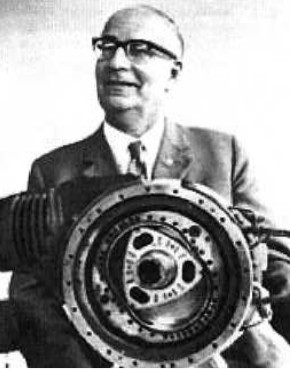
“Felix Wankel with the engine open”
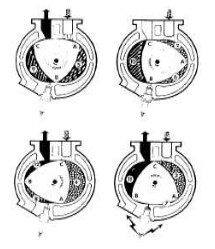
“How the Wankel Engine Works”
It operates on the principle of a four-stroke engine, but with three power strokes per piston revolution. This allows it to produce more power in a smaller engine.
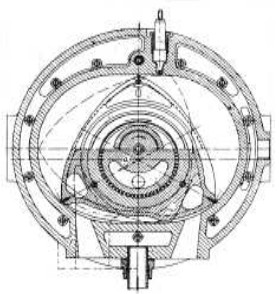
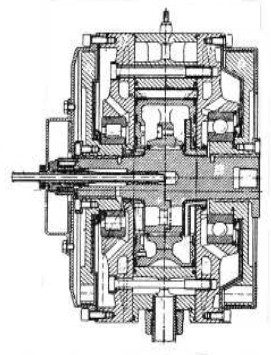
“Front and side section”
-In the section of a real engine, both front and side, we can see the triangular piston, ports, and spark plug, as well as the different coolant chambers surrounding the working area. All of this is housed within a flattened, cylindrical body, not oval.
-The sealing of the ends or vertices of the triangular piston and the sides themselves presented problems and solutions, leading to the design shown.
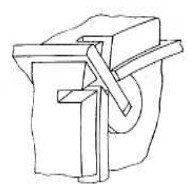
“Detail of the sealing”
-This engine is notable for its lack of reciprocating parts and, therefore, significant vibrations.
-In fact, when running, Wankel engines sound more like turbines.
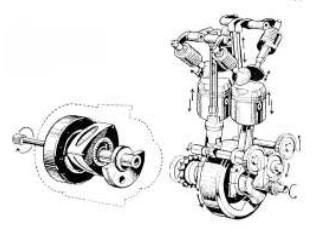
“Comparison of both systems”
-Below is a detailed exploded view illustration of the construction to provide greater detail of each part.
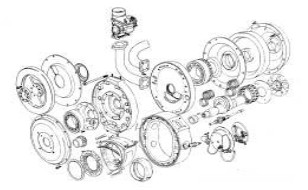
“Exploded view of a Wankel engine”
-Wankel itself has adapted its engines for aviation, such as the LOCR407SD.
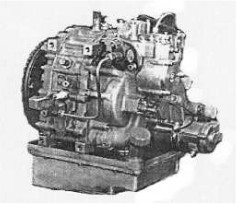
“Wankel LOCR407SD”
-Wankel markets several engines from two well-defined families: the 407 cc and the 814 cc, that is, the single-rotor and twin-rotor versions.
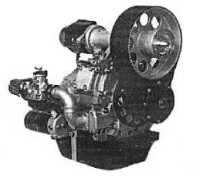
“Wankel LOCR407SG, with reduction gear”
-It produces 37 hp at 6,000 rpm, and it is offered with a reduction gear as the LOCR407SG, reaching 50 hp in this application.
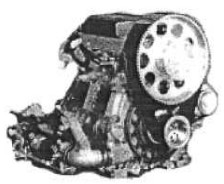
“Wankel LCR814TG”
-The twin-rotor version has a main difference in its fuel injection and liquid cooling. Like the previous model, it features a belt-driven reduction gear. This is the LCR814TGti. It produces 75 hp at 6,000 rpm.
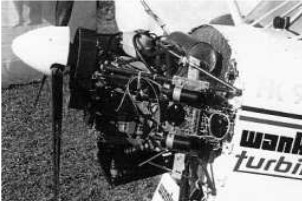
“Wankel Engine Application on Aircraft
-Many aircraft manufacturers are adapting Wankel engines for their aircraft, replacing traditional reciprocating piston engines.
-The list is growing.
-The argument is that smaller size provides the same power (remember that each piston revolution involves three power strokes and a low-speed stroke, similar to the whistling of a small turbine).
-These engines, being modular, can be assembled in one, two, three, or four modules.

“RV-4 Wankel Engine on the Mike-Wills”
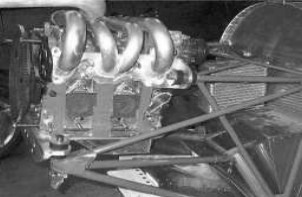
“Another RV-4 on the Bryan-Trubee”

“On the B. Alier Cosmo Aircraft”
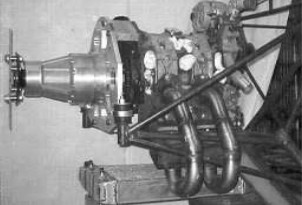
“A Two-Body Wankel Engine”
-And now an interesting American version in which the turbo shaft adds to the engine's power output, that is, a “Compound” system.
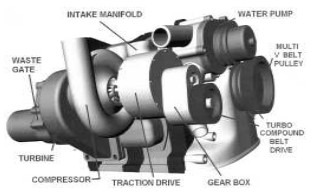
“CAD Design of a Wankel Compound Engine”
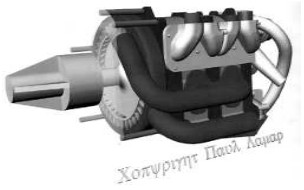
“And a Russian CAD design of a Wankel Compound engine with a large disc of vanes driven by the exhaust and connected to the power shaft.”
-Wankel engines have been used in cars like the Mazda and Sachs, and on motorcycles like the NSU, with considerable success in both applications.
-The Mazda engines have been well-suited for aviation; the "A-Z" text provides several examples.
-At the Musée des Arts et Métiers in Paris, another Wankel engine installed on an almost unknown Meteor motorcycle suggests that its applications are far more numerous than those published.
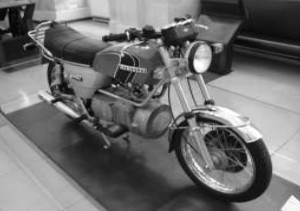
“Motorcycle with a Wankel Engine”
From Appendix 6: Since its invention by Dr. F. Wankel, there have been numerous versions and manufacturers producing it under license. Many engines have been based on it with slight variations, such as the Jernaes engine we're featuring here.
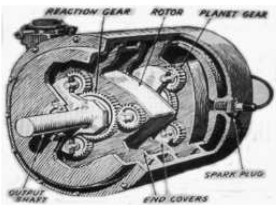
“Jernaes engine with variations”
- The piston engagement system is different, as is the triangular piston seal and the figure-eight-shaped cylinder walls.
- The Wankel engine has seen greater progress in the automotive sector, and as we've seen in this publication, those built for aviation (like Curtiss, John Deere, etc.) were largely abandoned. However, the Mazda engines have been the most successful, and they are installed on light aircraft.
- There has been a diesel variant, notable for its supercharger, which is another Wankel-type piston.
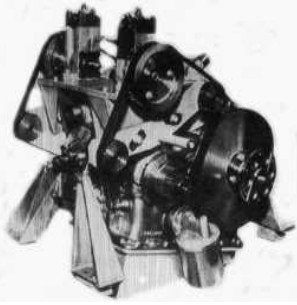
“Appearance of the Wankel Diesel”
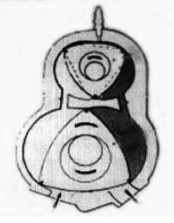
“Double rotor of the Diesel”
- The lower rotor supercharges the upper rotor, which has the injector instead of a spark plug. They operate in conjunction and are linked by gears. It appears that the PTO (Power Take-Off) is located on the lower piston, and the plate seems to be for a propeller.
-A major evolution of the Wankel engine was used in the Mercedes-Benz C-111 Mark II, producing 400 hp at 7,000 rpm. It was a four-barrel Wankel engine.
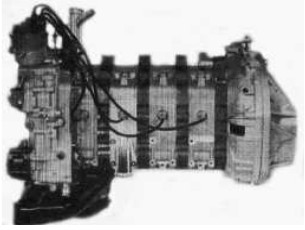
“Wankel Engine of the Mercedes C-111”
-William Thomas built small Wankel engines for aviation, with three-sided and five-sided pistons.
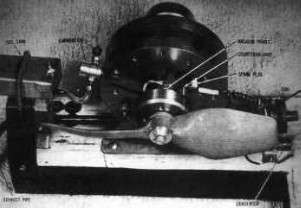
“The Thomas-Wankel Engine with Triangular Piston”
-The difference between the three-sided and five-sided pistons is shown below in two diagrams taken from PopSci, the Popular Science magazine from the early 1960s (a time when I was an avid reader).
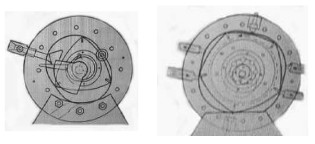
“The 3- and 5-Sided Thomas-Wankel Engines” (PeT)
-The appearance of the open cylinder with the five-sided piston is shown in the illustration below.

“Five-sided Thomas engine, open” (PeT)

“The five-sided piston engine on a test bench” (PeT)
- Wankel rotary engines are constantly evolving, as we are already seeing in this publication.
- Now we present a new one running on hydrogen.
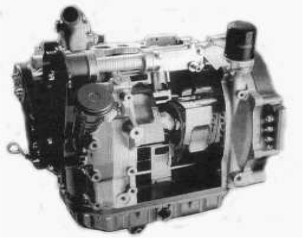
“View of the twin hydrogen Wankel engine”
- This engine in the illustration is shown sectioned to clearly observe the two rotary pistons.

“The German Fanliner”
- The Fanliner was one of the first light aircraft to install a Wankel engine. The shrouded propeller is located halfway along the fuselage, as we can see in this photograph.
- Subsequently, these engines began to proliferate in VLA and ULM aircraft, such as the American VLA-1 Sparrow.
- This aircraft has a Duncan-Wankel engine (see).
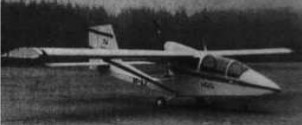
“Sparrow Ultralight, with Wankel Engine”
From Appendix 9: Dr. Wankel's German invention has evolved considerably in the automotive industry and even more so in its adaptation to light aviation, especially ultralights, VLAs, UAVs, etc.
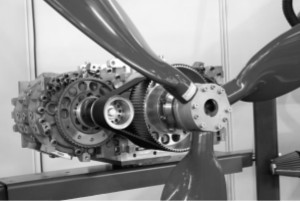
“A Twin Wankel Engine”
-Wankel engines are powerful for their size and rotate with virtually no vibration. However, in certain cases, engines are adapted to a coaxial shaft to drive a single propeller. This isn't the first instance; there are others.
Engines of WANKEL ROTARY
Model: LCR-407
Arquitecture:
Cooling:
Total Displacement:
Bore / Stroke: x
Power:
Weight:
Model: LCR-814
Arquitecture:
Cooling:
Total Displacement:
Bore / Stroke: x
Power:
Weight: