

Updated: 15-Oct-2025
This car brand has inspired enthusiasts to adapt its engines for light aviation.

“Volkswagen logo”
-The cooled, opposed-cylinder engines of the Beetle and the Van have been suitable for adaptation.
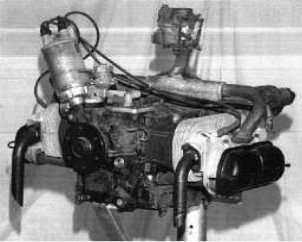
“An old VW engine, converted”
-Let's say the engines are these, in displacement values: 1192, 1200, 1280, 1400, 1500, 1550, 1600, 1650, 1680, 1700, 1834, 1835, 1875, 1915, 2000, 2017, 2050, 2074, 2100, 2180, 2200, 2450, 2498...
-Many engine manufacturers offer conversion kits.
-Even others, such as Rectimo, Stamo, Rollason, etc., offer them already converted for each type of aircraft.
There are two or three "Half VW" modifications, that is, half a Volkswagen engine, either by removing two cylinders without cutting the block or by cutting the block.
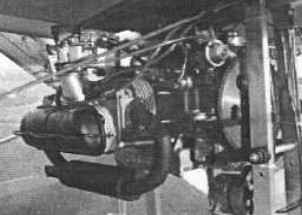
“VW engine installed on a ULM”
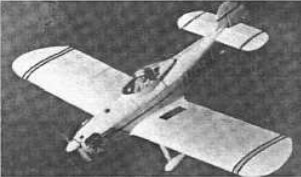
"Taylor monoplane with a VW engine"
From Appendix 6: The steady stream of new adaptations of VW automobile engines for use in general aviation continues.
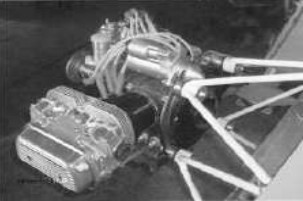
"Interesting engine mount on a direct-drive VW"
Between the engine mount and engine connections, we see a flywheel with a ring gear and the electric starter on top of the engine.
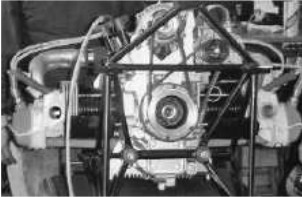
"Conversion in Brazil with 100 HP"
This other engine seen from the rear, with belts for a blower and a small alternator on top of the engine.
In this case, the engine mount supports the engine at two lower rear points and continues forward to reach two other front points.
Here's another view of the same VW engine in the 120 hp version from the front.
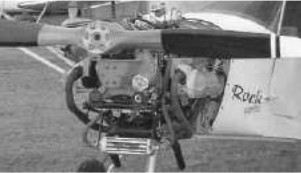
"Complete VW with gearbox and oil cooler"
The oil cooler is located below the engine, even below the exhaust muffler. Like the previous one, the engine mount reaches two lower front points of the engine.
Also interesting is the propeller reduction gearbox body, a cast monoblock that encompasses the entire lower pulley and serves as a good base for the upper one.
The carburetor appears above the engine. Presumably, the compressor is driven by the propeller shaft, its view obstructed by the propeller's horizontal position.
One of the VW Beetle-type car factories was in Brazil. We have observed many aircraft engines of this brand made in Europe, but this is the first time the author has located one from this South American country.
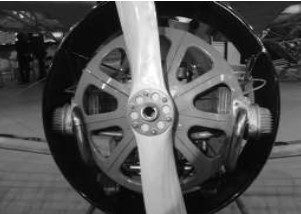
“A VW from Brazil on a Homebuilt”
Installed on a 3/4 scale model of the Polikarpov I-15, built in Barcelona. We can clearly see the opposed cylinders in the photograph.
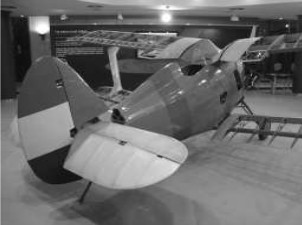
“3/4 flying model of the I-15”
The colors of the Spanish Republican flag appear on the rudder.
From Appendix 7: New adaptations of the Volkswagen car engine are continually appearing, such as the following in two views: the rear view with the starter ring gear and the front view with the toothed pulley reduction gear.
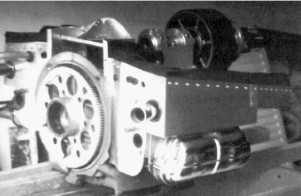
“The classic rocker cover”
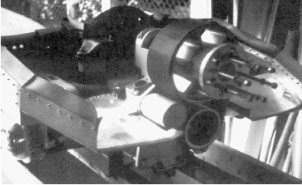
This application of a VW engine has the cooling box
From Appendix 9: This time the half-Volkswagen engine cut in half is from Germany, as examples of these “half-VW” reductions are generally Anglo-Saxon.
-The one we're showing was made by Mayer and Franz Serafin in 1966.
-They called it “Model Tiger” Type III and it was a Volkswagen 1500S engine, but with two cylinders, it only produced 30 hp with its 750 cc and two cylinders.
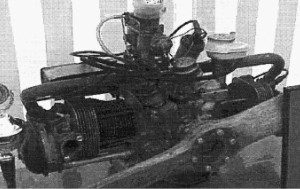

“Two photos of the Half-Volkswagen Engine
-And also from the same group, a complete Volkswagen engine, unbranded because it was a homemade adaptation.
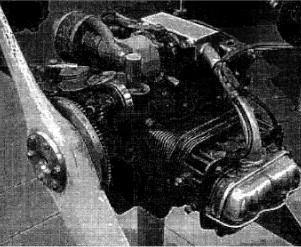
“A Volkswagen aircraft engine”
-An interesting air adaptation with a Scintilla Vertex magneto.
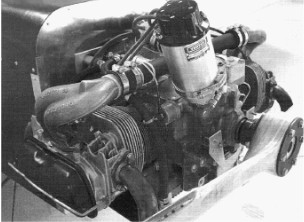
“Mounted Volkswagen engine with propeller”
-A “V” variant has been made in Russia.
-The cylinder blocks are made by VW. However, the author doesn't agree with the distances between the base and the bottom of the block. The distance is too small to accommodate the crankshaft.

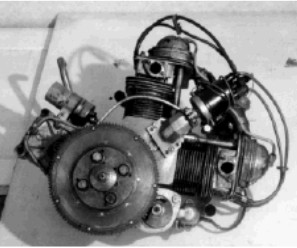
“Original engine shape”
-However, at the rear we have the fly wheel at the correct height, the electric starter, and the distributor correctly positioned.
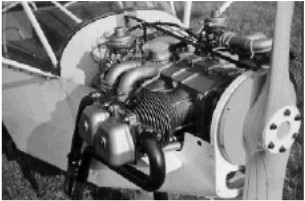
“Another highly polished VW modification”
-This is another modification in which the rocker covers are customized, and the intake manifolds are paired to connect to two Bing carburetors.
From Appendix 10: Photographs of the engines of these famous cars adapted for aviation use continue to appear.
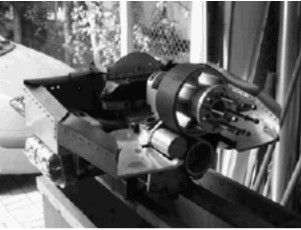
"Special Modification"
In this modification, we see that the reduction belt has a tension pulley.
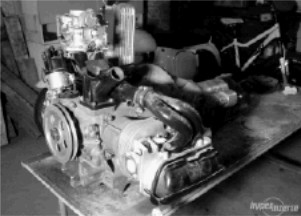
"Another VW-Brouk Modification"
It appears that the VW-Brouk was made in Czechoslovakia.
Every day that goes by, we are more amazed at the ingenuity of people who take these German car engines as a base and transform them in extremely unique ways.
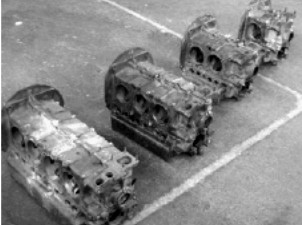
“Evolution of the original 4-cylinder engine”
-From the original four-cylinder engine, second to last on the right, the crankshaft blocks are cut and added or subtracted to obtain other 2, 6, and 8-cylinder engines.
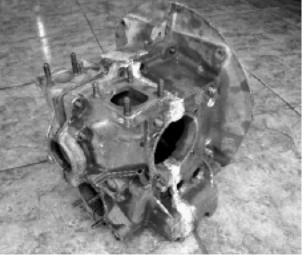
“Cylinder block cut and welded for a VW Half”
-The cut is made through the center of the cylinder bore or elsewhere to maintain consistency, as we see in all of them.
-The results are astonishing, and it's difficult to identify which engine—or engine base—it's being used.
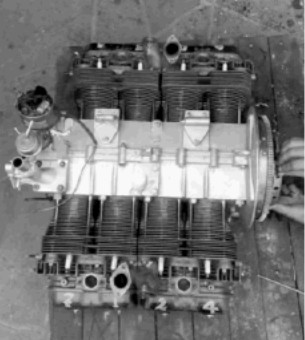
The version of an eight-cylinder VW engine
-Here we also clearly see the welded joint to create this eight-cylinder tandem VW Double.

"Strange engine designed and built in Peru"
This 6-cylinder engine appears in an article as a modified Volkswagen engine, but no part of this brand is identifiable unless the interior contains elements such as a VW crankshaft, connecting rods, pistons, and cylinders.
From Appendix 12: New photograph of an old Volkswagen car engine installation on an aircraft.
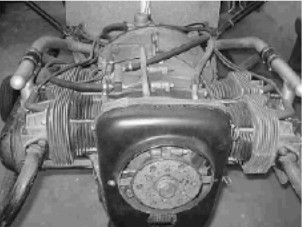
"VW, for a light aircraft"
At the front, we see the propeller plate and a kind of deflector cover. Behind, we see the tubular structure of the engine mount that holds the engine to the structure.
This superimposed VW turbocharger is an engineering feat. Made by Kawell-EMP for racing cars.
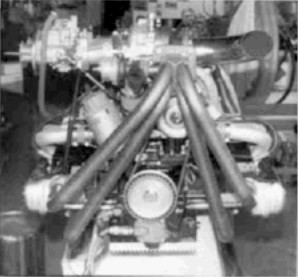
“Double VW, not an aircraft engine (for now)”
-With seven cylinders (and half cylinder heads) from the well-known VW 1200 engine, a Dutch enthusiast has built an interesting radial engine.
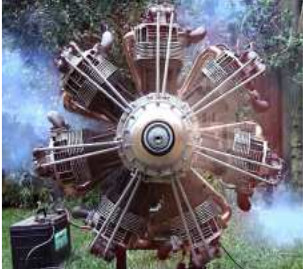
“The radial engine in operation”
-The builder is Arnold De Man. We can see the rocker arms and valve control rods exposed, so they will require pre-lubrication before starting up.
-Even the engine of the amphibious vehicle “Kubelwagen,” based on the “Beetle,” has been adapted for aviation, as is the case with the Polish JB-4 light aircraft.
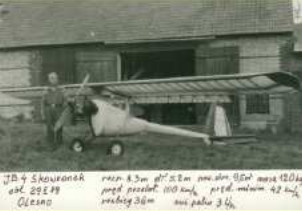
“The JB-4, built during WWII” (PiP-SP)
Engines of VOLKSWAGEN
Model: Adapted car engines
Arquitecture:
Cooling:
Total Displacement:
Bore / Stroke: x
Power:
Weight: