

Updated: 09-Jul-2021
(see PZL).
The Aircraft Construction Center, OKL or Osrodek Konstrukcji Lotniczych, was established in Warsaw around 1957.
-Regarding engines, various types were made. They built pulse jets, ramjets, piston engines and turbines.
-The Puls-10 and Puls-11 pulse jets were used to power gliders and the rotors of small low-thrust helicopters. They delivered 10 and 11 Kgf respectively.
-Other more unknown gave 40, 70 and up to 200 Kgf.
-During a certain time, Wicktor Narkiewicz was involved in this organization, leading the piston engine departments.
-One of the most important engines was the NP-1 with four horizontally-opposed cylinders giving 65 CV.
-The WN-3, a 7-cylinder radial gave 320/340 CV. The PZL-35 had two cylinders and delivered 35 CV. The WN-7 with 4 horizontally-opposed cylinders and its derivatives, gave 125 CV nominal (between 115 and 145 CV). The WZ-100 remained a prototype.
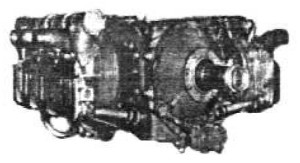
“WN-6B”
-The most successful engine was the WN-6 with 6 opposed cylinders that gave between 180 and 195 hp. Variants were the ungeared WN-6B and the geared WN-6RB. They were widely seen on Wilga and Tarpan aircraft. The WN-6S was for helicopters.
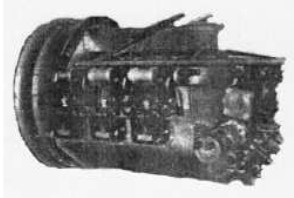
“WN-6S”
-Apart from the aforementioned piston engines, there is the one that was built under license from Ivchenko, the AI-26V. With seven cylinders it gave 575 CV and was known as LIT-3.
-The turbine department started with the development and tests of the TO-1, a very small turbojet with a centrifugal compressor delivering 400 Kgf of thrust.
-The next engine was the SO-1 turbojet with a 7-stage axial compressor, an annular combustion chamber, and a single turbine. It delivered from 900 to 1,060 Kgf of thrust. It was assigned to the "Iskra" trainer plane.
-The LIS-2A was manufactured under license. It was the Klimov VK-1 for the Polish MiG-15s.
-The LIS-5 was the Klimov VK-1A for the MiG-17s of the Polish air forces.
Engines of OKL
Model: LiS-2A
Arquitecture:
Compressor/s:
Combustion chambers:
Turbines:
Power / Thrust: / ---
Weight:
Model: LiS-5
Arquitecture:
Compressor/s:
Combustion chambers:
Turbines:
Power / Thrust: / ---
Weight:
Model: LiT-3
Arquitecture:
Cooling:
Total Displacement:
Bore / Stroke: x
Power: @ rpm
Weight:
Model: Motores W. Narkiewicz
Arquitecture:
Cooling:
Total Displacement:
Bore / Stroke:
Power:
Weight:
Model: NP-1
Arquitecture:
Cooling:
Total Displacement:
Bore / Stroke: x
Power:
Weight:
Model: Puls-10
Arquitecture:
Chambers:
Fuels:
Feed System:
Ignition:
Thrust:
Weight:
Model: Puls-11
Arquitecture:
Chambers:
Fuels:
Feed System:
Ignition:
Thrust:
Weight:
Model: SO-1
Arquitecture:
Compressor/s:
Combustion chambers:
Turbines:
Power / Thrust: / ---
Weight:
Model: TO-1
Arquitecture:
Compressor/s:
Combustion chambers:
Turbines:
Power / Thrust: / ---
Weight:
Model: WN-3
Arquitecture:
Cooling:
Total Displacement:
Bore / Stroke: x
Power:
Weight:
Model: WN-6B, S
Arquitecture:
Cooling:
Total Displacement:
Bore / Stroke: x
Power:
Weight: