

Updated: 28-Apr-2020
In 1913, Arturo Concaris founded FIMA (Fabbrica Italiana Motori Aviazione) in Torino, which from 1916 was dedicated to the repair and production of spare parts for the Gnome-Rhone and Hispano-Suiza engines.
-Later they made cars that were branded FAST.
-There is information that this Torino factory has also manufactured the LUCT. An engine that gave 80 CV at 1,100 rpm and was a six-stroke engine!
-The six-stroke system was established to improve cooling, ventilation and cylinder filling by entering a quantity of pure air during one of the stages to effect the sweep and to expel the residual gases. (sic).
-Around 1912 they built a 8-cylinder engine that gave 80CV.
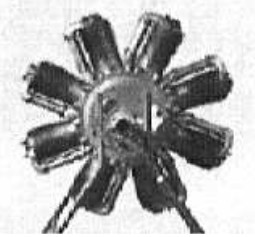
"Fima-LUCT, 80 CV"
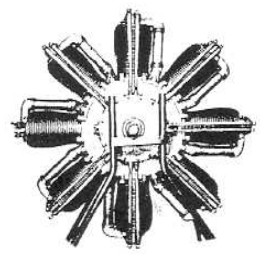
"Another view ow the 8-cylinder Fima-Luct"
-However, seeing the production of LUCT, in 1912 appears a 7-cylinder rotary engine that delivered 60/65 CV.
And in 1913 there are four more LUCT engines:
-A 7-cylinder rotary that gave 50 CV at 1,200 rpm. Model "B".
-Another one as model "C" giving 80 CV at 1,200 rpm with 9 cylinders, which was a rotary engine as well.
-The 80 CV "E" model rotary engine with 7 cylinders.
-The "F" model rotary giving 100 CV at 1,200 rpm with 9 cylinders that had the same size as the "E" model.
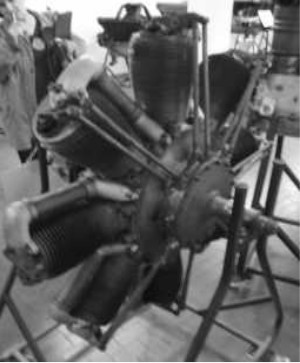
"LUCT at the Polito"
-This larger photo is made of the 8-cylinder, 80 CV Fima-Luct engine (6-stroke) that is exhibited at the Polytechnic Institute of Torino (El Polito).
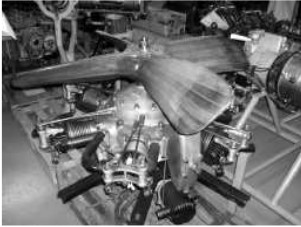
"Overturned FIMA engine with propeller"
-This Fima engine, manufactured in Torino, is located in the reserve warehouse of the Le Bourget MAE museum.
From Appendix 9: The existing motor in horizontal position, a radial with a fan of this same brand above it. It also has a plate indicating that the constructor is "A. Concaris "(A = Arturo), from Turin.
-Awaiting for an illustration during a next visit.
Engines of FIMA
Model: Gnome-LeRhone (Lic.)
Arquitecture:
Cooling:
Total Displacement:
Bore / Stroke: x
Power:
Weight:
Model: Hispano-Suiza (Lic.)
Arquitecture:
Cooling:
Total Displacement:
Bore / Stroke: x
Power:
Weight:
Model: Luct, 80 CV (Lic.)
Arquitecture: Rotary
Cooling:
Total Displacement:
Bore / Stroke:
Power: 80 CV
Weight:
6-stroke engine
Model: Model B, 7 cyl., rotary
Arquitecture: 7-cylinder Rotary
Cooling:
Total Displacement:
Bore / Stroke:
Power: 50 CV @ 1200 rpm
Weight:
Model: Model C, 9 cyl., rotary
Arquitecture: 9-cylinder Rotary
Cooling:
Total Displacement:
Bore / Stroke:
Power: 80 CV @ 1200 rpm
Weight:
Model: Model E, 7 cyl., rotary
Arquitecture: 7-cylinder Rotary
Cooling: Air
Total Displacement:
Bore / Stroke:
Power: 80 CV
Weight:
Model: Model F, 9 cyl., rotary
Arquitecture: 9-cylinder Rotary
Cooling: Air
Total Displacement:
Bore / Stroke:
Power: 100 CV @ 1200 rpm
Weight: