

Updated: 02-Oct-2026
Civil engineer Federico Cantero Villamil focused on electrohydraulics and railways, but his great passion was aeronautics, to which he dedicated time and financial resources, especially to the helicopter.
Once his prototype, the Spanish Dragonfly, with a double contra-rotating rotor, was completed in 1941, he continued to incorporate modifications (such as the second version with an anti-torque rotor in 1943) until his death in 1946.
We present two photographs of this second version taken at the Cuatro Vientos airfield in Madrid (1943).


“Photographs of Cantero's Spanish Libélula”
-With a 130 hp? Pobjoy engine showing below thanks to the superimposed reduction gear and a fan that was necessary for powerful stationary flights. Subsequent information gives the engine only 90 hp.
-These works have been unknown until today, when a family member has published a book about his interesting biography, titled with his name.
-For our publication we are interested in other patents on propulsion systems that were advanced for its time:
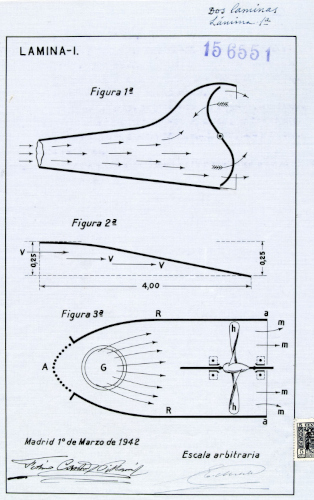
"Cantero's patent, no 156551"
-By his patent number 156551 from March 1942, we have a means to gain power (today PTO) through propellers installed in the gas flow of turbo-reactors (incipient at that time).
-On November 5 the same year he requested patent for an axial-flow turbojet (the Germans would still not have an operating equivalent -BMW or Jumo- until 1944).
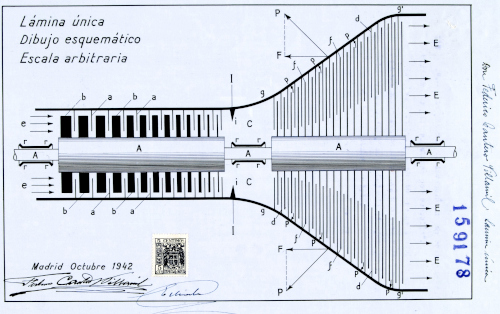
"Cantero's, number 159178"
-In 1944 (March) he was granted patent number 166043, for a nozzle with ejectors to "create spinning vortexes" to produce a better mixing with the exhaust gases in turbojets.
-Actually it is the booster principle that half a decade later was used by Melot.
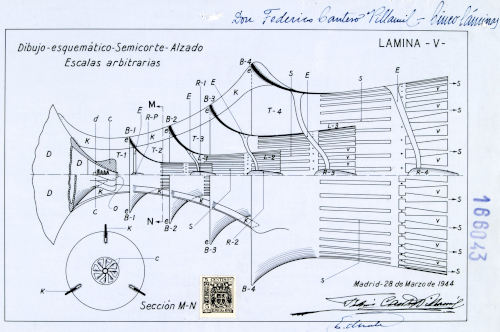
"Cantero's patent number 166043"
-Don't forget that Federico Cantero had previously obtained many patents on helicopters and their devices. He was contemporary of Sikorsky and the German FW-61, who made his first flight in WWII.
However, La Libélula Española was a pioneer in Spain. It's worth remembering that La Cierva invented the autogiro, based on different principles—it couldn't perform hovering flights.
From appendix 9: At the Spanish patent office they have located more works on jet propulsion by indefatigable engineer F. Cantero .
The main text deals with his most visible work: helicopters.
-The illustrations below are copies of original documents provided for the patent.
"Gas turbine"
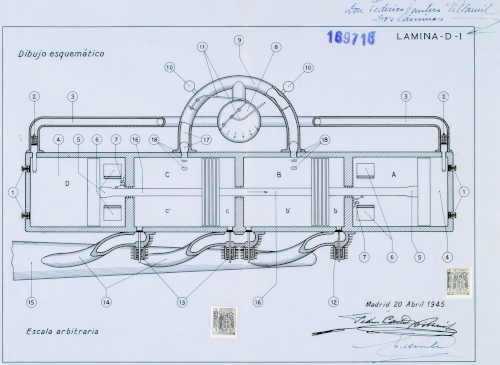
"Gas generator"
-The "free piston" type gas generator could be used to drive a turbine or directing pressurized gas to the blade tips of a helicopter rotor. Like in the illustration below.
-This generator is similar to Pescara. (see)
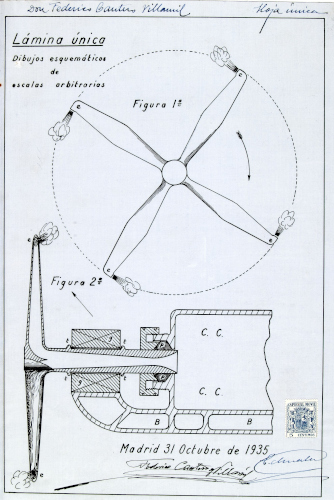
"Patent for a jet driven rotor"
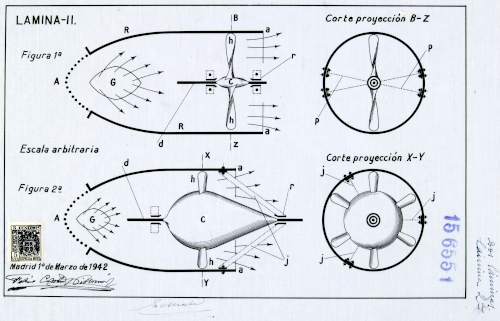
"Rotor driven by gas"
-As it is an incipient turbine, we need to study the accompanying text to assimilate its operation. A simpler system would be the one shown below.
"Spinning caused by gas flow "
-First the simplest form and after that the one shown in the figure above. The first one clearly makes the propeller spin with the gas from the free piston generator.
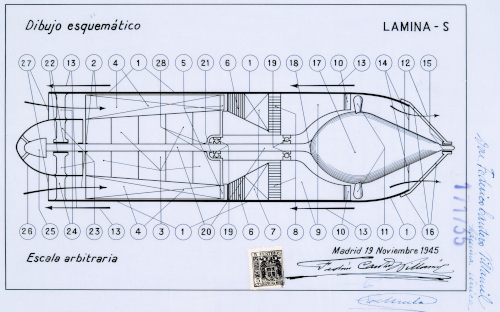
"Realistic turbojet from 1945"