

Updated: 14-May-2026
G. and J. Weir Ltd. of Cathard, Glasgow, ordered Dryad engines from Douglas for their Weir W.1 autogyro.
-The designers for Douglas, and especially for the Dryad engines, were Pullin and Walker, who later moved to Weir.
(Author's Note: In the Pullin chapter, the engine is described as a Pullin, when it appears to have been a Weir designed by Pullin.
-The Weir Flat Twin was produced between 1933 and 1935 and had a power output of 40-50 HP.
-This is the engine installed on the Weir W.2 autogyro pictured in the Pullin chapter.
-G. and J. Weir also produced an interesting engine: an inverted four-cylinder, air-cooled engine with an overhead camshaft. In this case, at the base of the engine.
- It was designed by Pullin and was known as the Weir Pixie engine. It dates from 1936.
- Aero Engines Ltd. of Bristol, which had attempted to manufacture Hispano-Suiza aircraft in England, decided to focus on the licensed production of British engines.
- This is what they did with the General Aircraft Ltd. Monarch model and the Weir Pixie.
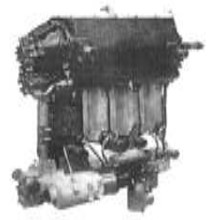

“Weir 1,5 l.”
- Producing 38/40 HP at 2,800 rpm, Weir manufactured it between 1936 and 1937.
From Appendix A5/6: Manufacturer of autogyros, helicopters, and engines used on them.
- The aircraft mentioned in the main text—and also referred to as the Pullin engine—is the W-2, illustrated below.

“W-2 of 1936”
-The W-4 was also a C.G. Pullin design, from 1937. In 1938, the W-5, with a twin rotor, was tested. The common engine used was the 50 HP four-cylinder air-cooled engine.

“The clearly experimental W-5”
Motores de WEIR
Model: 4 cyl. inverted, inline
Arquitecture:
Cooling:
Total Displacement:
Bore / Stroke: x
Power:
Weight:
Model: Twin-flat, 40-50 HP
Arquitecture:
Cooling:
Total Displacement:
Bore / Stroke: x
Power:
Weight:
Model: Weir-Pixie
Arquitecture:
Cooling:
Total Displacement:
Bore / Stroke: x
Power:
Weight: