

Updated: 21-Oct-2026
Williams International, founded in 1955 by Sam B. Williams as Williams Research (WR).
-He established a modest design office and began building small turbine engines for propelling unmanned vehicles and cruise missiles.
-Over time, they increased the size of their engines, eventually building turbojets for executive jets and air taxis, such as the FJ-44.
-The first one was the WR2, which produced 70 lbf of thrust.
-The WR2-6 version increased to 125 lbf of thrust.
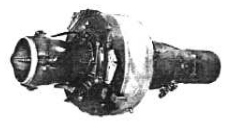
“Williams WR2-6”
-The WR24-6 and -7 were derived from this engine.

“WR24-7”
-The WR24-7 reached 170 lbf. of thrust, while the -17 produced 200 lbf. of thrust. Apparently identical at first glance.
-The WR24-6 was the military designation J400-WR-400, while the -7 was the J400-WR-401.
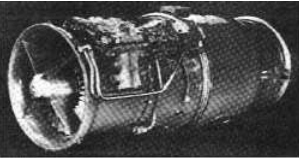
“WR19”
-The WR19s were twin-shaft engines based on the WR2, with the addition of an axial fan and compressor, and a bypass duct. By the time the WR19-7 was introduced, it was known as the F-107, a successful engine in its various versions, producing 600 lbf. of thrust.

“F-107”
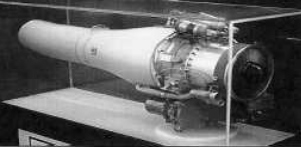

“F-107-WR-101”
-This turned out to be an advanced turbine, a twin-shaft turbofan engine intended for the USAF's AGM-86B Air Launched Cruise Missile (ALCM).

“ALCM Missile”
-The F-107-WR-100, WR-101, WR-102, WR-103, WR-104, and WR-400 engines were produced. Some of these were used on Tomahawk cruise missiles.

“F-107-WR-400”
-The WR19 “Jet Belt” was used for this personal vertical takeoff test (see Bell for a similar rocket test).
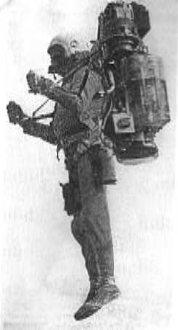
“WR19 Adaptation”
-The WR34 was a simple family of turbines with a very wide range of applications.
-The WR34-15 delivered 32 HP to the shaft. Used as an onboard auxiliary power unit.

“WR34 and WR34-15”
-The WR34 was designed for 15 to 50 HP and was used, among others, in the Canadair CL-227, around 1985.
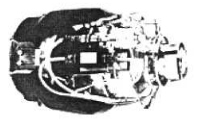
“WR34-16”
-The Canadair mentioned is an RPV (Revolutionary Pilot Vehicle), and the engine used was the WR34-16. The 50 HP mentioned was achieved with the turboshaft version of this same engine, the WTS34-16.

“WR9-7C”
-Another small family of Williams engines was the WR9, whose engine, the WR9-7C, was installed on the CC-115 “Buffalo”.
-With 82 HP at the shaft, it had an upgrade in the WR27-1 to 133 HP on the US Navy's Lockheed S-3.
-The WR-44 was larger. A twin-shaft turbofan, derived from the WR-19 and more specifically the -3-1 version, it proved to be extremely quiet. It started with 850 lbf. of thrust, soon reaching 1200 lbf.

“WR44”
-An engine for advanced missiles was the F-112. Initially, its performance was classified. Today we know that it produced 732 lbf. of maximum thrust in the F112-WR-100 version.
-An improved version of the F107-WR-101. The F112-WR-100 is built with radar-absorbing or "stealth" technology.

“F112-WR-100”
-The F121 is another small engine used on AGM-136A missiles such as the Tacit Rainbow, curiously with a limited lifespan of three hours.
-Thrust is only 70 lbf at 45,000 rpm. Axial compressor and two-stage turbine. The overall engine length is 40 inches by 5.5 inches in diameter.

“F121”
-The F121-WR-100 was used on the Rainbow DTS missile. The one pictured is on display at the USAF Museum.
-The above mentioned engines have lesser-known variants such as the WRC-19, the 1500 lbf WJ38-5, the 100 lbf WJ119, and the 125 shp WST117 of the Canadair CL-327.
-In 1989, Williams entered into agreements with Rolls-Royce to produce the FJ44 engines for executive aircraft, etc.

“RR-Williams FJ44”
-Williams-Rolls Inc. was founded for its development and to provide worldwide support.
-Below we show a cutaway image of the FJ44.
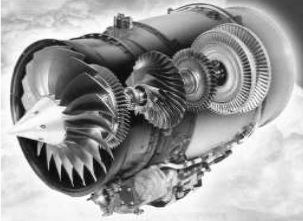
“FJ44 Rotor Shafts”
-The FJ44 is designed for 1900 lbf of nominal thrust. The FJ44's roots are clearly in the WR44, which looked identical but, through successive developments, doubled its power, as we see with the -2A at 2300 lbf, or the -2C at 2400 lbf.
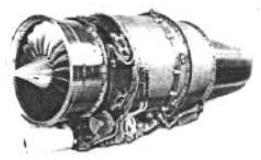
“FJ44, with nozzle”

“FJ44-3”
-The FJ44-3 and -3A, which looked identical, reached 3000 lbf. The fan with scimitar-shaped blades, or Arabian saber blades, was a notable feature.
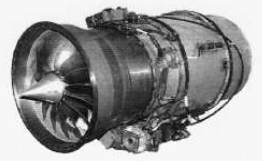
“RR-Williams FJ44-4”
-The FJ44-4 reached 3500 lbf of thrust, demonstrating how an engine could be developed to double its initial power. The FJ44 has a notable history in Cessna Citation Jet aircraft.

-Although not usually the case, the next model was the smaller FJ33, with 1200 to 1600 lbf. of thrust.

“FJ33”
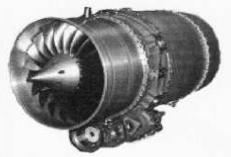
“FJ-33”
-The last FJ33 model, introduced in 2003, was the FJ33-4 with 1565 lbf. of thrust.

“FJ33-4”
We can see that there is hardly any difference in shape between the FJ33 and the FJ44. We would only notice the difference in size when placing them side by side.
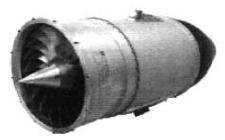
“FJ22”
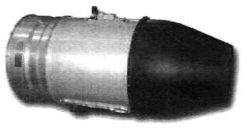
“Another FJ22”
-Continuing with the manufacturing line, another engine appears, even smaller, the FJ-22.
-It was planned to produce between 700 and 900 lbf. of thrust for the Eclipse 500 private business jet.
-But technical problems led the aircraft manufacturer to abandon the project in favor of the PWC-610F.
-Finally, we have projects like the FJX-1 with significant use of composites.
-It was presented at the 1997 Oshkosh Airshow. Or the FXJ-2, extremely small, as they are turbofans with 100 lbf. of thrust.
-As we can see below, it follows the design of the previous FJ-22.

“FXJ-2” (GAP Program-NASA)
-Currently, Williams is working on a turboprop, not yet certified in 2003, known as the TSX-2, derived from the FJ-22 and with approximately 500 shp.
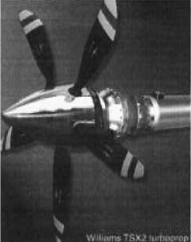
“Turbohélice TSX2”
From Appendix 6: The manufacturer of small and medium-sized aviation turbines began with units such as the WR-24-1 or the WR-27-1, as shown below, taken from Pleideanmedia.co.uk and AEHS.
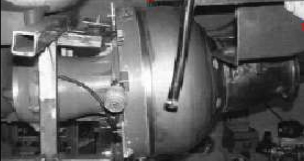
“Small WR-24-1 Turbojet” (PiP)

“APU Group, WR-27-1” (PiP)

“A very nice WR-2, cutaway” (photo P. Pisani)
-In the main text the WR-2 is only mentioned with no image.
-A photograph of the 718 lb WR19-3-1, from which the twin-shaft F-107 turbofan engine would be derived, was obtained. It was intended for use in various cruise missiles.

“Williams WR19-3-1”
-The WR19 has an interesting history; small and light, the WR19-3 model gave rise to the WR19-10.
The WR19-3 achieves 570 lbf. of thrust with a 12-inch bore, and its total weight with accessories, including the heavy starter-generator, is 141 lb.

“WR19-10”
The WR19-10 delivers 800 lbf. of thrust. Also known as the WR44-800.
This engine was the predecessor of the FJ44, which was hugely successful in general and executive aviation, as well as in the armed forces.

“The Lightness of Williams Engines”
On the left, a WR19-3, and on the right, a WR19-10.
“Williams WR-24 drone engine with 124 lbf of thrust”

“Williams WR-27”
Bell made rocket engines mounted on the back of the hypothetical soldier as an individual means of flight; this is their Rocket Belt.
The system Williams made is the Jet Belt, available in backpack and platform versions.

The Williams Jet Belt (PiP)
The Williams engine shown is a very memorable bypass engine.
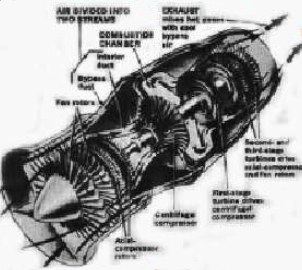
The Williams Turbojet (PiP)
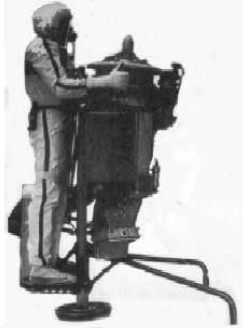
The Flying Platform (PiP=ps)
The main exhaust jet lifts the assembly, and the air from the bifurcated bypass also serves to balance and steer.
Williams made other turbine engines for land applications, such as the one for automobiles that we discovered now.
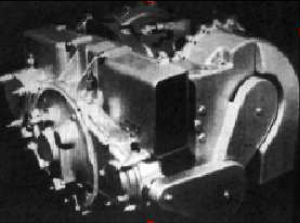
“Williams for Automotive” (PiP)
- Produces 80 HP at 4450 rpm in a small package measuring 65x60x40 cm.
- Interesting photograph of Sam Williams, a pioneer of the famous American aviation turbine company (see main text), when he presented a small engine capable of replacing the engine in an Army Jeep with the same equivalent power.
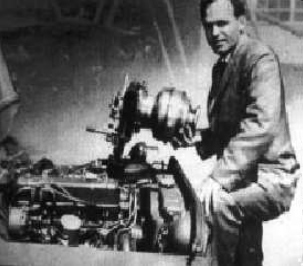
“Sam Williams with his engine” (PiP)
- Williams Research Corp. (the first Williams company) of Michigan presented this engine to the Army’s Detroit Ordnance Arsenal for consideration in the future of this vehicle.
- The presentation of the WR-19 engine is interesting, held by a flight attendant in the same air intake as the fan of a larger vehicle.

“The young lady bears the weight of the engine with ease.”
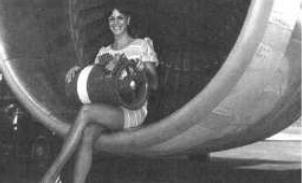
“Detail of the engine (and the young lady)"
-The small Williams WR-19 turbofan was used on the Jet Belt (see) and was suitable for cruise missiles, drones, UAVs, and some small aircraft.
From Appendix 7: We provide a couple of cross-sectional drawings of the WR2-6 and another of the WR24-7-2 with its fuel system.

“Williams WR2-6”
-WR stands for Williams Research. Spray fuel injection through the central shaft, which has four bearings (numbers 12, 20, and 26x2).
-Fuel inlet at 27. Nr. 29 is a governor, and 2 is an alternator. The compressor is centrifugal and the turbine is axial.
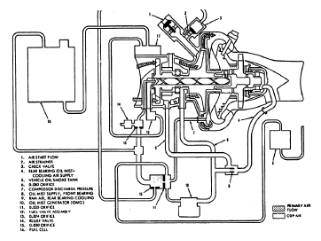
“Fuel, air, and oil system for the WR24-7-2”
-The fuel circuit from the main tank at the top left.
Engines of WILLIAMS INTERNATIONAL
Model: F-107 (WR-19)
Arquitecture:
Compressor/s:
Combustion chambers:
Turbines:
Power / Thrust: / ---
Weight:
Model: F-112
Arquitecture:
Compressor/s:
Combustion chambers:
Turbines:
Power / Thrust: / ---
Weight:
Model: F-121
Arquitecture:
Compressor/s:
Combustion chambers:
Turbines:
Power / Thrust: / ---
Weight:
Model: F-122
Arquitecture:
Compressor/s:
Combustion chambers:
Turbines:
Power / Thrust: / ---
Weight:
Model: F-129 (FJ-44)
Arquitecture:
Compressor/s:
Combustion chambers:
Turbines:
Power / Thrust:
Weight:
Model: F-415
Arquitecture:
Compressor/s:
Combustion chambers:
Turbines:
Power / Thrust: / ---
Weight:
Model: FJ-22
Arquitecture:
Compressor/s:
Combustion chambers:
Turbines:
Power / Thrust: / ---
Weight:
Model: FJ-33
Arquitecture:
Compressor/s:
Combustion chambers:
Turbines:
Power / Thrust: / ---
Weight:
Model: FXJ-2
Arquitecture:
Compressor/s:
Combustion chambers:
Turbines:
Power / Thrust: / ---
Weight:
Model: J-400 (WR-24)
Arquitecture:
Compressor/s:
Combustion chambers:
Turbines:
Power / Thrust: / ---
Weight:
Model: TSX2
Arquitecture:
Compressor/s:
Combustion chambers:
Turbines:
Power / Thrust: / ---
Weight:
Model: WJ-119
Arquitecture:
Compressor/s:
Combustion chambers:
Turbines:
Power / Thrust: / ---
Weight:
Model: WJ-38-5
Arquitecture:
Compressor/s:
Combustion chambers:
Turbines:
Power / Thrust: / ---
Weight:
Model: WR-2
Arquitecture:
Compressor/s:
Combustion chambers:
Turbines:
Power / Thrust: / ---
Weight:
Model: WR-24
Arquitecture:
Compressor/s:
Combustion chambers:
Turbines:
Power / Thrust: / ---
Weight:
Model: WR-27-1
Arquitecture:
Compressor/s:
Combustion chambers:
Turbines:
Power / Thrust: / ---
Weight:
Model: WR-34
Arquitecture:
Compressor/s:
Combustion chambers:
Turbines:
Power / Thrust: / ---
Weight:
Model: WR-44
Arquitecture:
Compressor/s:
Combustion chambers:
Turbines:
Power / Thrust: / ---
Weight:
Model: WR-9
Arquitecture:
Compressor/s:
Combustion chambers:
Turbines:
Power / Thrust: / ---
Weight:
Model: WRC-19 (F-124)
Arquitecture:
Compressor/s:
Combustion chambers:
Turbines:
Power / Thrust: / ---
Weight:
Model: WST-117
Arquitecture:
Compressor/s:
Combustion chambers:
Turbines:
Power / Thrust: / ---
Weight:
Model: WTS-34
Arquitecture:
Compressor/s:
Combustion chambers:
Turbines:
Power / Thrust: / ---
Weight: