

Updated: 27-Oct-2025
Trajan Vuia was a Romanian pioneer who moved to Paris in 1909, where he tested his Vuia No. 1 airplane.
-It used a Serpollet automobile engine, running on carbon dioxide. See Serpollet.
-To achieve this, he made radical modifications to its main characteristics, first improving the power-to-weight ratio by lightening and varying various working components.
-The engine was fueled with the aforementioned carbon dioxide, and the tank had a capacity of 13 liters.
-It weighed a total of 105 kg and produced 20 hp for 5 minutes, sufficient time for the planned experimental flights.
-A heater with 12 Bunsen burners for a small boiler maintained a constant pressure of 45 bar.
-The anhydrous coal remained liquid without freezing, and with very little heat input, it gasified into steam. In fact, it was 1/10 of what it would cost to heat water.
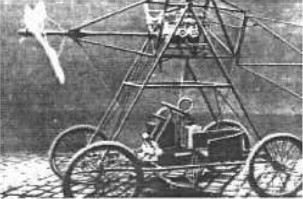
“Vuia No. 1”
- Using a tap that acted as an accelerator, this carbon dioxide gas or vapor at 45 bar went to the engine itself.
- A photo of the life-size model on display at the MAE Museum is provided. A close look reveals the actual size of the Serpollet engine and the devices used to create pressure with the carbon dioxide.

“Vuia's device with a Serpollet engine”
Engines of VUIA
Model: Modified Serpollet
Arquitecture:
Cooling:
Total Displacement:
Bore / Stroke: x
Power:
Weight: