

Updated: 24-Oct-2025
Known by the name Von Braun, his name was Wernher. A pioneer in the design and construction of rocket engines.
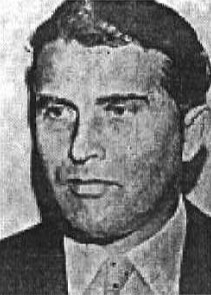
“Wernher Von Braun”
He was born in 1912 in Wirsitz, Pose, Germany.
His passion for rocketry, his professional training, and circumstances led him during WWII to direct the construction of the V-2 rockets (Aggregate A-4).
German Revenge or Retaliation Weapon, used at the end of the war.
The official designation of the V-2 was actually Von Braun's A-4 at EMW.
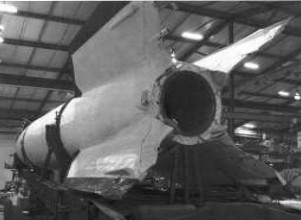
"V-2 Rocket"
On the V-2, the engine was actually a combustion chamber, fueled by liquid oxygen and alcohol.
The tanks occupied most of the weapon's central body.
-The explosive load was in the front cone, and the guidance and stabilization devices were located slightly behind it.
-Below we see the engine design. See the EMW chapter for more information, especially the photograph of the engine on display at the Cité de l'Espace in Toulouse.
-The chamber has a double wall through which the fuel circulates to cool it, from bottom to top until it exits through the various pre-chambers filled with injector holes.
-This can be seen in the EMW photograph and in the following schematic of the pre-chamber injector assembly. It is noted that there is a direct inlet for the alcohol in the center.
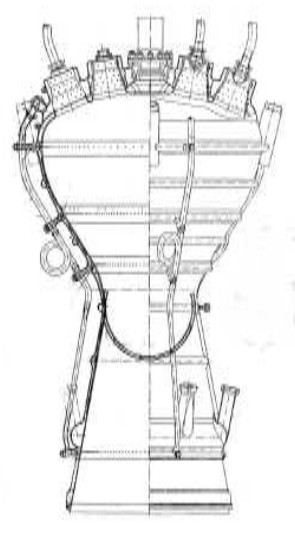
“A-4 (V-2) Engine”
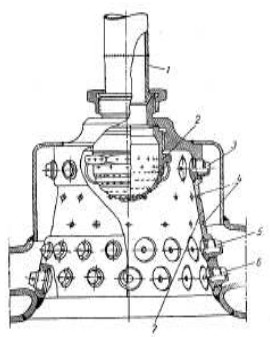
“Detail of a pre-chamber”
-The engine was powered by high-speed, high-flow turbopumps.
The exhaust from these turbopumps is directed toward the main engine nozzle, parallel to and adding to the total thrust.
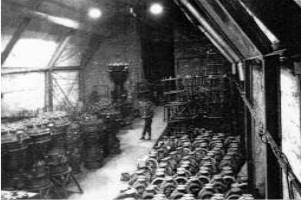
“V-2 Engine Assembly”
The turbopumps ran on other fuels. A steam generator used hydrogen peroxide and calcium permanganate.
In addition to the missile's external fins, the nozzle outlet could have four small graphite fins—in later models—to direct the jet toward the steering control.
At the end of the war, when Von Braun moved to the West, he joined NASA.
He is credited with several rockets, but the one that culminated his career was the Saturn V, which took man to the Moon.
-Early in the USA, studies are known from 1952, such as the Von Braun-1 engine running on nitric acid and UDMH, with a power of 31,200 kgf for 84 seconds.
-The Von Braun-2 engine with a power of 47,000 kgf for 124 seconds.
-Or the Von Braun-3 engine with a power of 40,000 kgf for 84 seconds.
-In the USA, the V-2 engine was tested and built (as in the USSR), evolving to higher power levels.
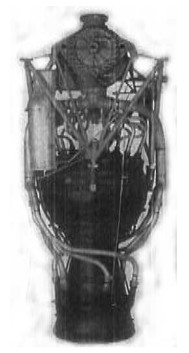
“V-2 USA Version”
-In the photograph, we see the engine and turbopump assembly in the upper part. The connection to the lower part of the nozzle is clear, allowing it to flow through the double wall to the prechambers.
-In his autobiography, "Erste Fahrt zum Mond," the schematic designs of the main rocket engines appear.
For example, the solid-fuel rocket is a sealed cylinder except for the outlet in the form of a Laval nozzle. It has fuel load and an ignition system.
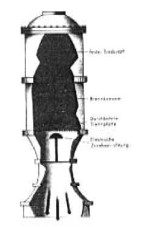
“Solid fuel Rocket”
-In liquid rockets, fuel can be supplied by turbopumps or by pressurizing the tanks, as shown below.
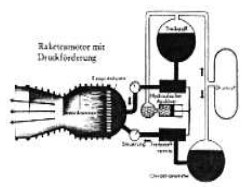
“Pressured fuel supply"
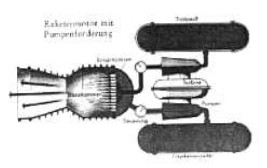
“Fuel supply by turbopump”
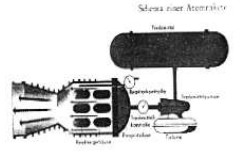
“Atomic Rocket”
-Continuing with the V-2 (A-4) engine, we show the engine used for R&D.
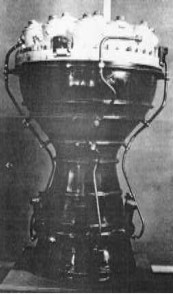
“V-2 Engine”
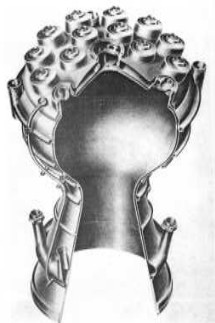
“Cutaway of a Rocket Engine”
-The engine used in the first A-4s was like the one shown below, with a slightly different shape.
This can also be seen in the silhouette of the aforementioned rocket.
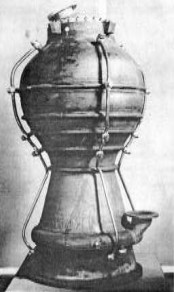
“Early A-4 Engine”
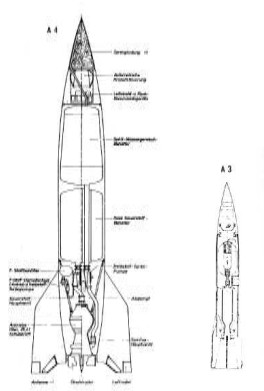
“A-4 and A-3”
-The A-3 (like the A-5) was about half the height of the A-4 and also half the diameter.
-The A-3 and A-5 engines were very similar in design to the A-2 (see Nebel) but much larger.
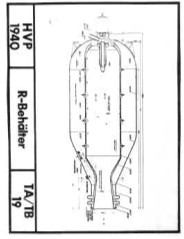
“A-5 Rocket Engine”
-As in the Aggregate 2 (A-2), the fuel tank surrounds the combustion chamber.
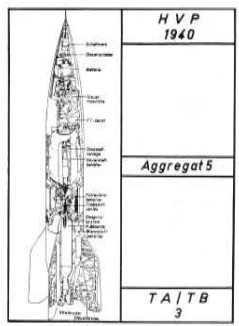
“Aggregat 5 (A-5)”
-Note that the initials HVP refer to the Army Experimental Center in Peenemünde, camouflaged under the initials EMW or “Elektro Mechanische Werke”.
Engines of VON BRAUN
We have no more detailed engine information for this brand. We continue our search. Any help will be appreciated.