

Updated: 14-Aug-2023
Societé de Constructions Aeriens Rossel-Peugeot in Sochaux (Doubs) and Suresnes (Seine) with head engineer M. Rossel manufactured the large 7-cylinder that we can see in the photograph.
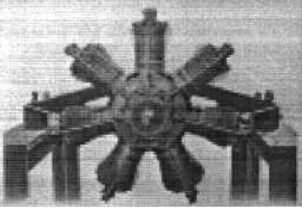
“Rossel - Peugeot”
-Outwardly it looks like a Gnome but its construction differs remarkably, for its 50 CV the weight is much less.
-The Rossel-Peugeot radial rotary engine gave 50 CV.
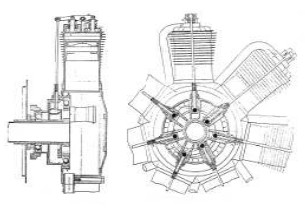
“Rossel Peugeot schematic drawing”
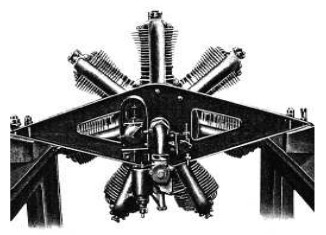
"Rossel Peugeot photograph"
-But perhaps the most interesting detail is the movement system of the valves, like the Viale -see-, that is, desmodromic.
-A plate has some tracks where sliders activate the control rods for the distribution valves.
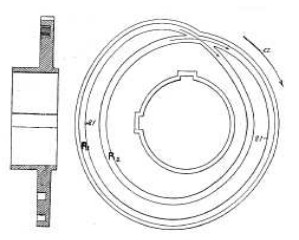
“Distribution plate”
-There were two types of this engine, one with a crankshaft sticking out from both ends of the crankcase and another one sticking out from one end only.
-It had 105 mm bore by 110 mm stroke.
-Rossel-Peugeot built a range of 2 and 4-stroke engines with powers between 25 and 100 HP.
From Appendix 10: New photograph of this desmodromic controlled valve motor by engineer Rossel.
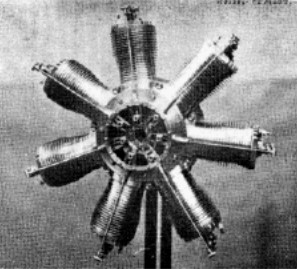
“Rossel-Peugeot rotary engine”
-Since there is no front cover (nor propeller hub) we see the interior of the slotted disc plate and some rollers that have the sliders that are inserted into said slots, lifting and stretching the valves. no springs
Engines of ROSSEL - PEUGEOT
Model: 7 cyl. radial, 50 HP
Arquitecture:
Cooling:
Total Displacement:
Bore / Stroke: x
Power:
Weight: