

Updated: 15-Jun-2018
Jacob C.H. Ellehammer designed and made several radial engines for aviation.
-The 3-cylinder engine gave rise to the 6-cylinder coupling two of the former ones.
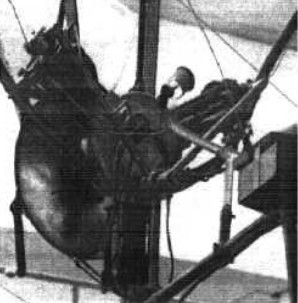
"3-cylinder Ellehammer"
-The three-cylinder is at the Danish Technical Museum, in Helsingor. There we can see that the engine is between the wings of the biplane, and the propeller is driven by a belt as it is on the upper plane.
-The 5-cylinder gave 30 CV at 900 rpm and was mounted on the biplane of the same name in 1909.
-We see the union with braces between the cylinders. These were made of cast iron.
-The triangulation of the braces gave rigidity to the whole. Each cylinder head had a controlled exhaust valve and holes at the end of the expansion stroke to assist in the evacuation of burned gases.
-The intake was made through the crankcase and by an automatic valve through the piston (in the style of Gnome Monosoupape). It was used in another Ellehammer airplane.
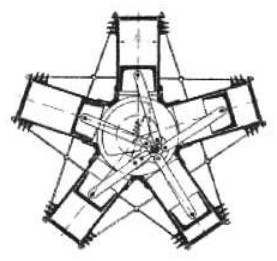
"Ellehammer 5-cylinder"
-Next an Ellehammer seven-cylinder rear view.
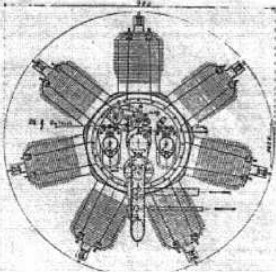
"Ellehammer 7-cylinder"
-We discovered a six-cylinder Ellehammer, double row of three, with the cylinder heads braced with straps.
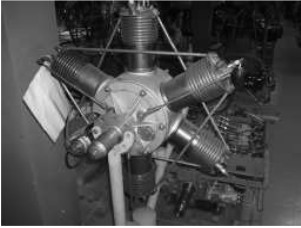
"Ellehammer radial 6-cylinder"
-The one in the photograph is at the MAE Engine Reserve Store.
From Appendix 6: Jacob Christian Hansen Ellehammer. The first engine was a radial with 3 Peugeot cylinders giving 9 CV only. It was manufactured in 1904-1905.
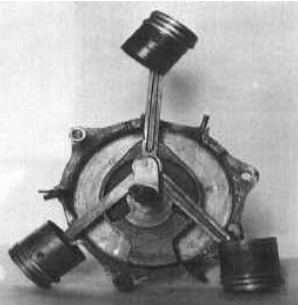
"Connecting rod system for the first 3-cylinder"
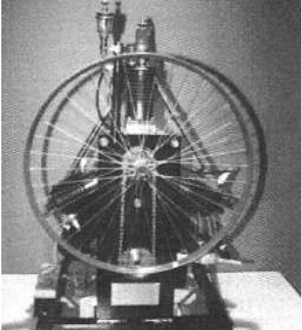
"The Ellehammer 3-cylinder from 1904"
-In 1906 a three-cylinder would give 18 CV.
-In 1907 he made the 5-cylinder with 30 CV. The 7-cylinder is from 1908 inspired perhaps by a Gnome.
-In 1909 the double row radial with 6 cylinders in total gave 36 CV, It was used on the Standard Monoplane and on a helicopter by 1912.
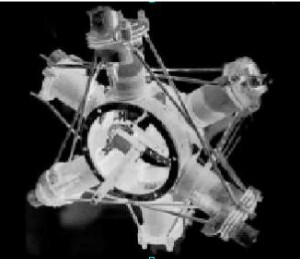
"A primitive 6-cylinder (2x3)"
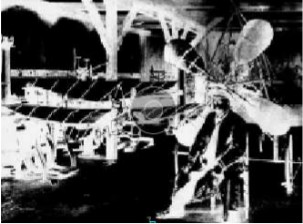
"Ellehammer in his workshop, behind the 6-cylinder"
-Between 1913 and 1914 he made the 80 CV 6-cylinder, presented in several countries and especially in Paris.
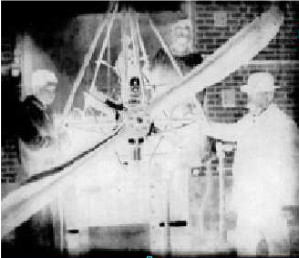
"Demonstration in Paris, 1914" (PiP)
-It is in 1916-1917 when he builds the 12-cylinder radial, which was a double 6-cylinder giving 160 CV.
-In 1929, the picture of Jacob shown below was taken, showing the 80 CV, and, as we can see, braced by the cylinder heads.
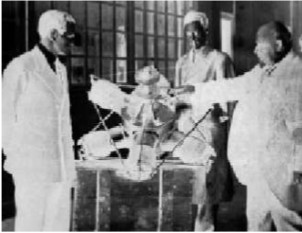
“Jacob Ellehammer in front of a 6-cylinder” (PiP)
-And in 1932 builds the three-cylinder radial but already with 115 CV.
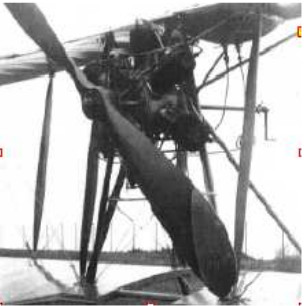
"The 80 CV with 6 cylinders on the Maagen"
-The Maagen hydroplane (Donnet-Leveque) with the Ellehammer engine.
From Appendix 9: At the Danmarks Flyvemuseum Museum in Helsingor there is a three-cylinder, two-stroke radial. It has triangulation bracing and a circular front exhaust.
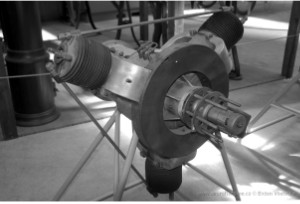
"Ellehammer 2-stroke, 3-cylinder"
-Fixed single-cylinder engine, possibly for land vehicle.
--The rest of aeronautical engines will be radials and rotaries.
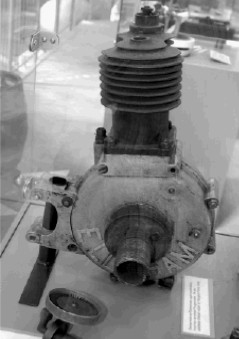
“Ellehammer single-cylinder” (photo E-V)
-Six-cylinder engine located at the Helsingor Museum. The engine is from 1914.
-It has the characteristic tie rods with the cylinder heads. See main text.
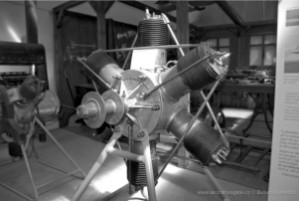
"The Ellehammer 6-cylinder"
From Appendix 10: Ellehammer himself piloting one of his devices with his own engines.
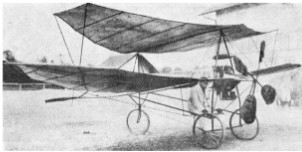
“The mentioned photo”
Engines of ELLEHAMMER
Model: 1 cil. fijo
Arquitecture: Single-cylinder
Cooling: Air
Total Displacement:
Bore / Stroke:
Power:
Weight:
"Ellehammer single-cylinder engine"
Model: 12 cils. radial-rotativo, (2x6 cils), 160 CV
Arquitecture: 2-stroke12-cylinder Rotary
Cooling: Air
Total Displacement:
Bore / Stroke:
Power: 160 CV
Weight:
Model: 3 cils. radial rotativo, 18 CV
Arquitecture: 2-stroke3-cylinder Rotary
Cooling: Air
Total Displacement:
Bore / Stroke:
Power: 18 CV
Weight:
Model: 3 cils. radial rotativo, 9 CV
Arquitecture: 2-stroke3-cylinder Rotary
Cooling: Air
Total Displacement:
Bore / Stroke:
Power: 9 CV
Weight:
"Ellehammer, 3-cylinder from 1904"
Model: 5 cils. radial rotativo, 30 CV
Arquitecture: 2-stroke5-cylinder Rotary
Cooling: Air
Total Displacement:
Bore / Stroke:
Power: 30 CV @ 900 rpm
Weight:
Model: 6 cils. radial rotativo (2x3 cils), 80 HP
Arquitecture: 2-stroke6-cylinder Rotary
Cooling: Air
Total Displacement:
Bore / Stroke:
Power: 36 CV
Weight:
"Ellehammer, 6-cylinder radial"
Model: 7 cils. radial rotativo (1908)
Arquitecture: 2-stroke Rotary
Cooling: Air
Total Displacement:
Bore / Stroke:
Power:
Weight: