

Updated: 05-Feb-2020
(ver Caproni-Campini).
Mr. Secondo Campini was the Italian pioneer of jet propulsion, but without the gas turbine concept.
-What he was developing, was a motorjet. In the first project he used a radial piston engine and in the second one a V-12: A 900 hp Isotta-Faschini drove a compressor.
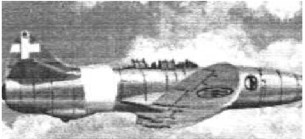
"CC-2"
-The supplied air passed to the rear of the aircraft where a large annular chamber and injectors heated the air that then left through the adjustable end nozzle at higher speed.
-It is said that with a propeller and the 900 CV from the fitted engine it had obtained better performances.
-Fuel consumption was extortionate. The first tests were made in 1940 and two projects, the CC-1 and CC-2, were done.
From Appendix 10: Illustrations with Campini pre-projects, built by Caproni.
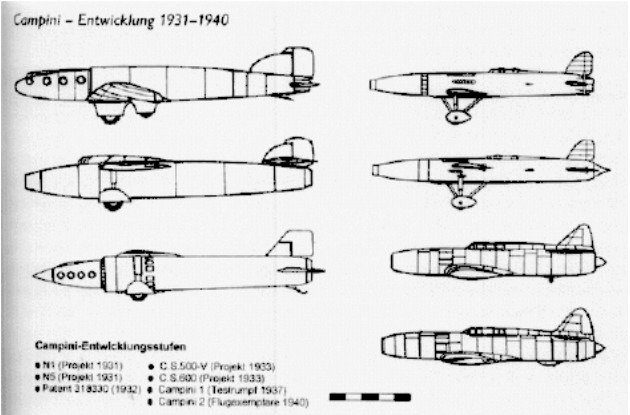
"The last two on the right are those that were used as CC.1 and CC.2"
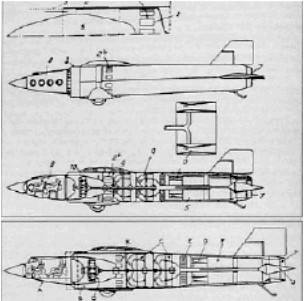
-As we see in the picture above, the whole fuselage was a motorjet.
-In this case a radial engine drives two centrifugal compressors with one active side, placed in line, that feeds a combustion chamber at the rear, like an afterburner.
-For each flight condition a mobile warhead varied the section of the outlet.
-The achieved thrust was very low and consumption extremely high, not being suitable for operation or useful. It was an essay that undoubtedly contributed to the progress of jet engines.
-At the Vigna del Valle Museum there is a complete unit.
Engines of CAMPINI
Model: CC-1, motoreactor
Power: @ rpm Other details:
A radial piston engine drove a compressor.
Model: CC-2, motoreactor
Power: @ rpm Other details:
An Isotta-Faschini V-12 piston engine that delivered 900 CV drove a compressor.