

Updated: 30-Jan-2024
This is the “Socièté Française de Fabrication Aeronautique” that made a pair of radial engines around 1929.
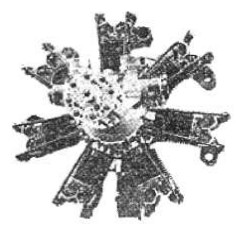
“SFFA, A model”
-At the Paris Air Show it presented two models of radial engines, the A with seven cylinders and the B with three.
-The A was a seven-cylinder that gave 90 CV. What stands out is the arrangement of the exhaust pipes that improve the emptying of the cylinders as the plane advances.
Author's note: Just like the Packard Diesel engine, this made the plane dirtier and if it was installed in the bow of the fuselage, the gases flowed to the pilot and/or passenger, thus poisoning them.
-If the intention is good, the idea is bad in itself: the exhaust gases must be properly redirected.
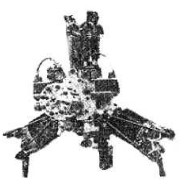
“SFFA, B model”
-The three-cylinder, model B gave 40/45 CV.
From Appendix 10: Below we show the cover of a Manuel d'Entretien (Maintenance or Service Manual) in which it is mentioned that it is the Type A engine.
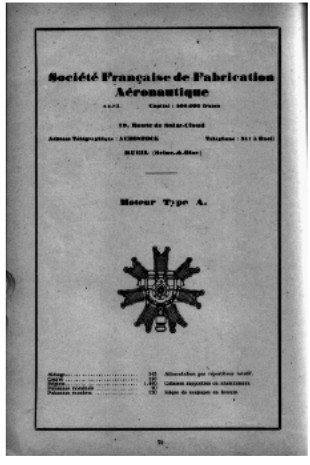
“Cover of the Type A manual”
This engine had 7 cylinders and gave 90 CV. Unlike the one described in the main text, it does not have longitudinal exhaust ducts.
-Although it does have the magnetos in the same arrangement as the Lawrance and Wright Whirlwind (J-1 to J-5)
Engines of SFFA
Model: Model A
Arquitecture:
Cooling:
Total Displacement:
Bore / Stroke: x
Power:
Weight:
Model: Model B
Arquitecture:
Cooling:
Total Displacement:
Bore / Stroke: x
Power:
Weight: