

Updated: 30-Jul-2020
Miesse made a 100 CV, horizontally, 8-cylinder radial engine with a vertical crankshaft. It was mounted on the Belgian De la Hault helicopter in 1908.
From Appendix 7: Before the First World War, this brand of engines offered two models, a four-cylinder 50-60 CV and the 100 CV 8-cylinder.
From Appendix 9: No image of this brand appears in the main text. Now we have found one in an old, translated text.
-It is a twelve cylinder (?) Although the author only counts eight. The magneto is on top of the engine.
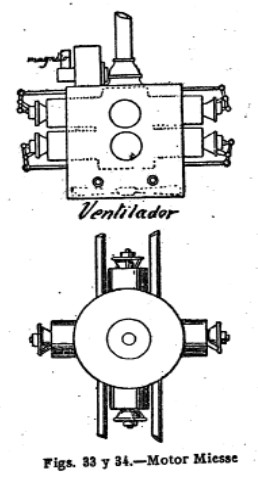
“Miesse engine drawing”
-It gave 120 CV weighing 92 Kg. In the Spanish translation, the crankshaft crankpin journals are mentioned as “manetones”.
-It is insisted that the crankshaft with two crankpin journals, each of them was connected with 6 connecting rods "with the help of a special connection that allows a wide useful range to be obtained".
-Referring to the contradiction of 8 or 12 cylinders, it could be that the author refers to two engines: one in the text and the other in the figure below it.
-The cylinders have cooling fins and under the engine there is a fan.
From Appendix 12: This brand appears in an old UK publication. Possibly a licensed representative or manufacturer.
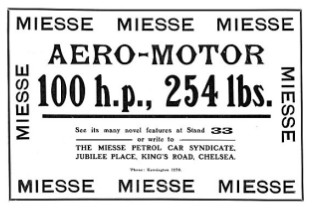
“Miesse 100 CV UK ad”
Engines of MIESSE
Model: 4-cyl.
Arquitecture:
Cooling:
Total Displacement:
Bore / Stroke: x
Power:
Weight:
Model: 6-cyl
Arquitecture:
Cooling:
Total Displacement:
Bore / Stroke: x
Power:
Weight:
Model: 8-cyl. hor.
Arquitecture: Radial
Cooling:
Total Displacement:
Bore / Stroke:
Power:
Weight:
Radial engine with vertical crankshaft