

Updated: 11-Oct-2026
Gustav Whitehead designed two-stroke engines with a special feature: the cylinder bodies were wrapped with wire that transferred heat to the surrounding air.

“1903 Whitehead engine”
-The 1903 Whitehead engine had two cylinders with a two-stroke cycle, and the cylinders were wrapped in aluminum wire.

“1904 Whitehead engine”
-Similarly, the 1904 model was wrapped in wire to facilitate cooling, instead of the classic fins.

“1906 Whitehead engine”
-We can clearly see the wire on the cylinders frayed with age on the 1906 engine. Also a two-stroke, two-cylinder engine, it produced 6 HP at 1000 rpm and weighed 35 pounds.
-In 1909, a four-cylinder, water-cooled engine was built, still a two-stroke engine (see ports at BDC), producing 75 HP at 1200 rpm and weighing 200 pounds.

“1909 Whitehead engine”
-The 1909 Beach biplane used a 5-cylinder Whitehead engine with automatic intake valves and 50 HP. It had 127 x 140 mm cylinders.
From Appendix 6: It has been discovered that Whitehead was actually a German immigrant to the United States born as Gustav Weisskopf. In the US he changed his surname to Whitehead.
-In his hometown of Leutershausen, Germany, he is considered a pioneer, and there is the Gustav Weisskopf Museum housed in a beautiful building.

"The Gustav Weisskopf Museum"
-It is recorded that on August 14, 1901, he made a powered flight in an airplane of his own design.
-And the engine was also of his own design.
-This occurred more than two years before the Wright brothers' flight in December 1903.
-So we have another point of contention: remember that the French also claim Ader's flight, and the British claim Henson's.

“Whitehead Airplane No. 21”
-The engine, a model, is on display in the aforementioned museum and is shown below.
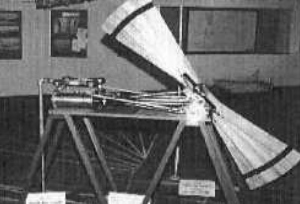
“Possible replica of the No. 21 engine”
-An authentic photograph of the previous twin-cylinder engine is also available.

“Weiskopf's (Whitehead's) Twin-Cylinder Engine”
-Another photograph from that period shows Gustav himself with an early engine, already incorporating the idea of wire wrapped around the cylinder to dissipate heat. We can see a kind of primitive crankcase in its construction.

“Gustav with an early single-cylinder engine”

“Twin-Cylinder Version”
-We also have a damaged photograph that clearly identifies it as a two-stroke engine with four cylinders.
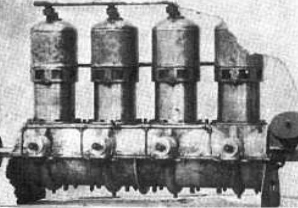
“The 1909 Water-Cooled Engine”
-The main text provides supplementary information on some of the material mentioned in this appendix.
-Finally, the installation of this last engine on an aircraft of the time.

“An onboard installation”
From Appendix 10: Below we show an ad of the time.

“Ad for 3 Whitehead engines”
-"Designed by the well known engineer and motor expert Gustave Whitehead". The ad is quite remarkable, as it claims to be the latest innovation, as if it were a passing fad (the small engine is from 1903, and the advertisement is from 1911), the best built, the lightest, and above all, the world-famous.
-And it goes on to say that it doesn't use cams, springs, or valves. Naturally: they are two-stroke engines.
-It clarifies for us that there were three models marketed: the 25 HP, the 40 HP, and the 75 HP.
Motores de WHITEHEAD
Model: 2-cyl. 1903
Arquitecture:
Cooling:
Total Displacement:
Bore / Stroke: x
Power:
Weight:
Model: 2-cyl. 1904
Arquitecture:
Cooling:
Total Displacement:
Bore / Stroke: x
Power:
Weight:
Model: 2-cyl. 1906
Arquitecture:
Cooling:
Total Displacement:
Bore / Stroke: x
Power:
Weight:
Model: 4 cyl. inline 1909
Arquitecture:
Cooling:
Total Displacement:
Bore / Stroke: x
Power:
Weight: